Archive | February 2015

Girl gaga! Ha! Gotta love spam.

spam

“What i do not understood is in fact how you’re no longer really a
lot more smartly-favored than you may be right now.
You are very intelligent. You know therefore significantly in terms of this topic, produced me in my
opinion imagine it from so many varied angles.
Its like women and men aren’t interested except it’s one thing to accomplish with Girl gaga!
Your personal stuffs nice. Always maintain it up”

Yes, girl gaga – I has it. Sometimes the spam comments really amuse me 🙂 This particular bit of poorly translated spammage has popped up a few times, makes me laugh every time!

Maintain it up, my friends, maintain it up . . .

Our Camp Grenada – Apologies to Mr. Sherman


10987581_10204571985113145_2190576825444754095_n

Found sillies from the shoebox – I love rediscovering things I jotted down and tucked away . . . She was likely a pre-teen when I presented this one to her. It had no effect on the state of her room. Ever.

I may revise it for her and her husband.

My silly lyrics loosely based on what I remember of Camp Grenada by Alan Sherman – This version is lovingly dedicated to my daughter, my inspiration, my messy muse if you will. I dramatized things just a tad, but the premise of this little ditty is based on actual events, my husband and I are still in therapy, but things are getting better by the day.

I’ve actually had this tune stuck in my head since 1977 I believe, at least the tune to the first verse, I’m not certain if it even has any variation in tune between stanzas, all I know is it haunts me. It never leaves. It’s the fault of my sweet little troll sister. She sang it repeatedly from the age of five until just shy of her ninth birthday. I wonder if she even remembers the song.

This is your muddah,

and your fadahh,

we’re writing to ya,

our dear daughta,

we’d like to say that,

we really love ya,

but if you don’t clean your room we’re gonna holla.

We are standing,

in your room now,

things are movin,

and things are crawlin,

dad looks mad now,

I feel like bawlin,

if we’re not careful we could end up fallin.

There’s that new game that,

we just bought ya,

it’s in pieces

neath your fadahh.

It wasn’t his fault,

now just keep readin,

I’m pretty sure that I can stop the bleedin’

I see garbage,

he sees dishes,

we both wish that,

we had three wishes,

we would wish that,

things were cleaner,

or maybe we

could just be meaner.

Maybe we should,

get outta here now,

it’s getting dark and,

I feel fear now.

What if we can’t,

find our way out,

I don’t think that there’s a clear escape route.

Oh my dear daughta,

it’s getting hotta,

it’s been hours,

since we’ve had watta,

we are thirsty,

and we are hungry,

maybe there’s a snack under that laundry.

Your faddah’s searching,

beneath the pile,

it seems to go on,

for miles and miles.

I don’t see him,

and I don’t hear him,

oh I hope that he’s not suffacatin.

I’m going in now,

it’s been an hour,

I’ve got to find him,

he’ll need a shower.

When I reach him,

I will hold him,

I just hope and pray that he’s still breathin.

Oh dearest daughta,

things look real bad,

I hope we make it,

don’t be too sad,

if we’re unconscious,

when you find us,

just resuscitate me first and then your dad.

By the way dear,

you are grounded,

no matter how this,

letter sounded,

we would rather,

throw your junk away,

than look at this big mess for even one more day.

Sincerest of apologies to Mr. Sherman . . .

Crystal R. Cook

Magical Doorways

Magical Doorways

The classics . . . pieces of art and history, penned by the hands of literary masters, caretakers, and keepers of words; their works have stood the test of time, remaining while all else changes . . . forever.

My childhood was filled with magic and mystery, drama and suspense. I was a time traveler and a princess, a mighty hero and a damsel in distress. I’ve flown round the world and journeyed to the center of the earth. I had grand adventures when I was young. I could go anywhere and do anything because my mother led me to a me a magical doorway, an entrance into another world.

She gave me a wonderful gift when she taught me to read, it was my key to unlock the doors of imagination and knowledge. When I was six years old I found a weathered copy of The Old Man and The Sea, I read it front to back without pause; I’ve read it many times since. The same softly covered book, printed and bound in nineteen fifty-two, holds a place of honor in not only my memory, but in my home as well. Once I stepped beyond the boundaries of everyday reality into the wondrous world of literature there was nothing I did not desire to read.

Herman Melville and Ernest Hemingway were my best friends. Shakespeare and Mark Twain accompanied me to school quite often. Hawthorne and Homer waited patiently for me at the end of each day. I’ve been to secret gardens and lived in enchanted castles. I’ve known the greatest of love and have felt the deepest of sorrow. I played with Tom Sawyer and Huckleberry Finn; I’ve even been to the moon and back again. I’ve sat along the shores of the great grey-green, greasy Limpopo River with the elephant’s child and pondered what the crocodile ate for diner. I bravely ventured into the mind of Poe.

I remember going to the fair with Charlotte and Templeton and investigating every mystery with the Hardy Boys. I was in the skiff with the old man Santiago and I felt the wind in my hair as I rode atop Black Beauty. My tears stained the pages where the red fern grew.

Aesop, Anderson and Kipling often joined me for lunch with James and his companions beneath the giant peach tree in the backyard. I traveled with Bilbo Baggins of Bag End and met the great wizard Gandalf. I befriended elves and fought ogres in search of the ring.

I held hands with Jesus in stories from the Bible and I was with Daniel in the lion’s den. I stood atop Mt. Ararat and gazed upon the most beautiful rainbow with Noah. I’ve been both young and old, taken many forms and seen many places. I’ve ridden high atop unicorns and slain dragons. I’ve even soared on the wings of angels.

I will forever be thankful to those who penned their dreams and fantasies, for in doing so; they bestowed upon me a treasure of great worth. I adore my books, though the pages have aged and the bindings have seen better days, I still go back to them, I visit my old friends often, adding new ones along the way. I never know where the magic door will take me or who will be my guide. It may be a quest for infinite wisdom or a marvelous retreat into days long since passed. Perhaps the future awaits my arrival on some distant star.

Who knows, maybe it lies within me, just waiting to be printed and bound . . .

Crystal R. Cook

The Origin & Etymology of QWIETPLEEZ

image

Since beginning this lovely blogging journey of mine, I’ve been asked many a time why my bloggy little corner of cyberspace is called the The Qwiet Muse, and I’ve thus far had no less than 5 well meaning folks inform me I spelled quiet wrong, you know, just in case spell check didn’t catch it. So sweet. To put those helpful minds at ease, let me issue an assurance to all, I spelled it that way on purpose. I had to fight spell check to do it to.

So we’ll start with the muse part. I love the word muse. Words often have more than one meaning, you may see the word muse and envision some ethereal goddess floating overhead, gently guiding and inspiring, but I have to say, if some ghostly apparition was hovering overhead, encouraging me to write, I would run.

Muse can also be defined as an instance or period of reflection, a source of inspiration . . . my particular muse comes from everything around me; my faith, my family, my friends. My muse exists in all the wonders of God’s creation and in my own human experience.

Onto to the origins and etymology of ‘qwiet’.

qwi-et [kwahy-it] adjective. Basic definition – it’s the same as quiet. It’s the same word, with the obvious distinction of containing a W in place of the U.

making no noise or sound, especially no disturbing sound: qwiet children.
free, or comparatively free, from noise: a qwiet house.
silent: Be qwiet!
restrained in speech, manner, etc.; saying little: a qwiet person.
free from disturbance or tumult; tranquil; peaceful: a qwiet life.

verb
to make qwiet.
to make tranquil or peaceful; pacify: to qwiet a crying baby.
to calm mentally, as a person.
to allay (tumult, doubt, fear, etc.).
to silence.

Origin: 1997; English(ish). Derived from (adj.) Middle English quiet < Latin quiētus, past participle of quiēscere ; (v.) Middle English quieten, partly derivative of the adj., partly < Late Latin quiētāre, derivative of quiētus.

*credit and apologies to dictionary.com

Historical Account:

In the summer of 1997, a young mother set about creating her first AOL.com email account. Her beginning attempts all ended in failure, every name she chose was unavailable. She wanted something witty, something fun, and something memorable. After several hours and many (many) unsuccessful attempts, her frustrations began to rise, as did the playful rambunctiousness of her four, young children.

Her attempts at quieting them were as unsuccessful as creating the perfect screen-name. Finding it increasingly hard to think, she found herself repeatedly requesting silence from the little house trolls. Calm down, lower your voices, hush, go to the other room, knock it off, zip it, chill out, and other such requests went ignored.

Her final, semi-shouted command to shush their pie-holes, not only stilled the room of sound for a blessed moment, but became her victory at the keyboard as well.

“JUST – BE – QUIETPLEASE!”

She was filled with trepidation, dreading another unavailable message but she pressed on, one key after the other. Q w i e t p l e e z. That was it! It was perfect! Her finger hovered over the enter key, she closed her eyes and pressed the button. When she opened them, the message said success!

So, I suppose you’ve guessed it, that young mother was me.

And there you have it, the origins of qwietpleez which lent itself quite adorably, at least to me, as inspiration for the creation of The Qwiet Muse.

Oh, by the way, I realize please is spelled wrong, I like it that way.

Crystal R.Cook aka Qwietpleez

Light it Up – Anthem for my children – Burn, let it burn.

This song, Bonfire by Building 429 is my anthem for my children . . . When I heard these words they rolled down my cheeks. I want my children to be proud of who they are, to stand for what they believe and never be ashamed or let anyone try to dim their light. This song says so much of what I have always tried to instill in them. My babies burn bright – Powerful – Like a modern day version of This Little Light of Mine – Let it burn.

BONFIRE

My mama always said I was born for this
And some people wouldn’t like that I was different
It never really mattered how hard it would be
Cause she filled me with love and the strength to lead
She said, “Oh oh, that kid’s a flame”
Said, “Oh oh, that kid’s a flame.
He’s gonna burn something down if you get in his way”

I came to light it up
Light it up
Light it up
If I was born to be a flame, then I wanna light a bonfire
Light it up
Light it up
Light it up
If I was born to be a flame, then I wanna light a bonfire
(Boom) Let it burn, let it burn
I’m gonna burn something down if you get in my way

This is the shout out, this is my voice
Calling all the men, women, girls and boys
The dropouts and losers, the hurt and the broke
Time to reclaim what the darkness has stole
Marching to the beat of a different drum
We live for the love, without counting the cost
If you wanna be free, then it’s time to go
Lift up your hand so the world will know!

We came to light it up,
Light it up
Light it up
If we were born to be a flame, then we’re gonna light a bonfire
Light it up
Light it up
Light it up
If we were born to be a flame, then we’re gonna light a bonfire
(Boom) Let it burn, let it burn
We’re gonna burn something down if you get in our way

We are not meant to be silent
We are alive just to shine
We are not meant to be quiet
We are the light of the world, we’ve gotta light-light-light it up

“Oh oh, that kid’s a flame”
Said, “Oh oh, that kid’s a flame.
He’s gonna burn something down if you get in his way”

We came to light it up
Light it up
Light it up
If we were born to be a flame, then we’re gonna light a bonfire
Light it up
Light it up
Light it up
If we were born to be a flame, then we’re gonna light a bonfire
(Boom) Let it burn, let it burn
We’re gonna burn something down if you get in our way

He was nine when he wrote it – This is how autism sometimes speaks.


Compassion comes in many forms, I think on this day, my son’s capacity for compassion and empathy and understanding of a world we so often take for granted shone bright in its innocence and purity . . .

imageThere are those who say autistic people do not have the capability to feel empathy or compassion or relate to the emotional world around them. I know this to be untrue, they may express these feelings differently than others, but they are more than capable of feeling them.

When my children were young we spent many afternoons in the park. Sometimes, when I drive past it, I can almost see them playing there, I hear their innocent laughter between the beats of my heart. One of these outings stands out in my memory, it was a beautiful and brisk autumn day, the perfect kind of day for something special.

Two of my four children are autistic, one is quite social and loves to run and play, the other is very much the opposite. He prefers to be still, watching, listening, taking in everything around him. While his brothers and sister quickly ran out into the open field to play, he spent the afternoon with his arms wrapped around a tree, he wrote this poem when he got home, he was nine years old.

VOICES OF NATURE

The wind chills me
as I walk the path
through the park

I hear a small voice
that is heard with my heart
It says “come to me”

I search for the source
of the mystical voice
there is only a single tree
ancient and weathered
roots exposed to the sun and the rain

The voice draws me nearer
and I see tiny little ants
crawling about
in search of food

I knew it was not them
that called out to me

I look to the top of the tree
the bare branches sadden me
I touch the tree
and feel enormous pain

Somehow the tree had spoken to me
maybe it is my gift

I sit next to the giant trunk
and speak to it for a while
it forgets its pain

I wrap my arms around it
as far as I can reach
I press my forehead
against the bumpy surface
and I think it’s thoughts
and I feel all that it feels
and it is thankful

Wilson Cook

1000 Voices Speak for Compassion

Waking Up is Hard to Do (with apologies to Neil Sedakis)

  Not a morning person. A morning person, I am not.

image

Do-do-do yawn dooby doo yawn, yawn. Comma, comma, yawn dooby doo yawn, yawn. Comma, comma, yawn dooby doo yawn, yawn. Waking up is hard to do.

Don’t take my dreams away from me,

don’t make me wake up, I’m so sleepy,

you know I’ll be mad at you,

cause waking up is hard to do.

Remember when you held me tight,

and then we snored all through the night,

think of how we slept right through,

now waking up is hard to do.

They say that waking up is hard to do,

now we both know that it’s true.

Don’t say that this has to end,

instead of waking up,

I wish that were were sleeping in again.

I’m begging you don’t make me rise,

can’t we give our sleep more time?

Come on baby, let’s fall asleep,

cause waking up is hard to do.

(they say that waking up is hard to do)

Oh I know, I know that it’s true.

(don’t say that this dream must end)

Instead of waking up I wish that we were sleeping sound again.

I beg of you don’t say to rise,

can’t we give our dreams another try?

Come on baby, let’s stay asleep, cause waking up is hard to do.

(Yawn dooby doo yawn, yawn) Comma, comma, yawn dooby doo yawn yawn. Comma, comma, yawn dooby doo yawn, yawn. Comma, comma, yawn dooby doo yawn, yawn. Comma, comma, yawn dooby doo yawn . . .

Where’s my coffee?

Crystal R.Cook

image

Original by Neil Sedakis – Breaking up is hard to do –

Do do do, Down dooby doo down, down. Comma, comma, down dooby doo down, down Comma, comma, down dooby doo down, down. Breaking up is hard to do.

Don’t take your love away from me

Don’t you leave my heart in misery

If you go then I’ll be blue

Cause breaking up is hard to do

Remember when you held me tight

And you kissed me all through the night

Think of all that we’ve been through

And breaking up is hard to do

They say that breaking up is hard to do

Now I know, I know that it’s true

Don’t say that this is the end

Instead of breaking up

I wish that we were making up again

I beg of you don’t say goodbye

Can’t we give our love another try?

Come on, baby, let’s start anew

Cause breaking up is hard to do

(They say that breaking up is hard to do)

Now I know I know that it’s true

(Don’t say that this is the end)

Instead of breaking up I wish that we were making up again

I beg of you don’t say goodbye

Can’t we give our love another try?

Come on, baby, let’s start anew

Cause breaking up is hard to do

(Down dooby doo down down) Comma, comma, down dooby doo down down Comma, comma, down dooby doo down down Comma, comma, down dooby doo down down Comma, comma, down dooby doo down

Eleventy thousand things, cobwebs, poetic advice, & rhyme.

I have eleventy thousand things to do, that’s just a rough estimate, mind you, (eleventy is a thing, my thing) — by my estimation I have time enough to complete approximately three of these things, and this is assuming I remove myself from the computer reasonably soon.

Problem. I would rather write. Or read. Or nap. –sigh-

Of course, writing is among the eleventy thousand things I must do, and for some of this writing, looming deadlines are attached. I’ve already procrastinated past the point of saying it can wait one more day. Today is kind of that day. –ugh-

Since the new bloggy bit I would rather be writing is going to have to wait, I’m dusting off the cobwebs from one of my early posts, which was seen by five people according to the statistical analysis of The Qwiet Muse. Actually, I am going to kind of, sort of, merge two posts together since the subject matter fits, and now that I’ve read them, I find pieces and parts I want to change, fix, adjust, add to, and . . . –argh- no time.

Now I must be productive and responsible and –extended sigh- get to work . . . I am going to need more coffee.

Poetic Perfection?
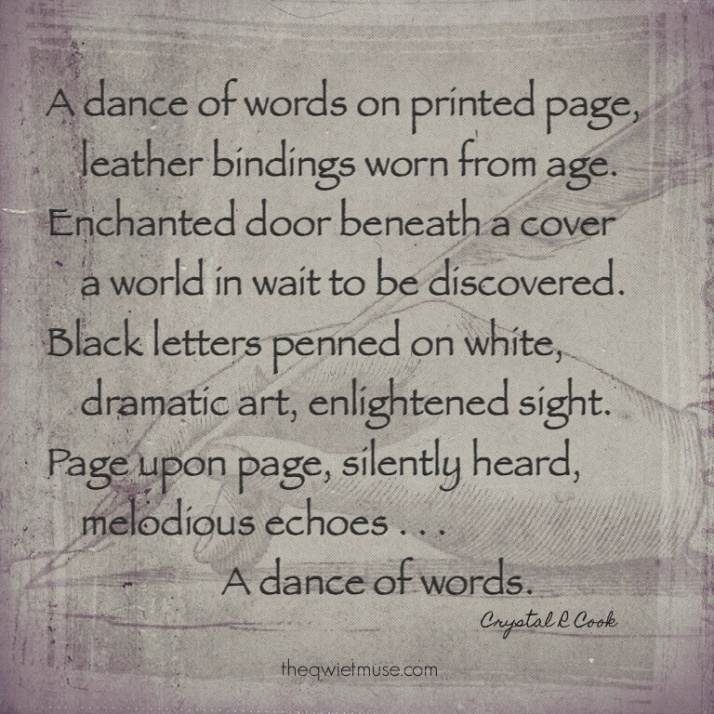
Dance of Words by Crystal R. Cook

Is there truly such thing as a perfect poem? What reads like unblemished perfection to one, may not receive the same praises from another. Poetry is a subjective art. There are guidelines a writer can follow which may endear their words to a greater audience of readers. The words of a poem provide the reader sustenance with which they can quell their hunger, but the presentation, the way in which the writer chooses to craft their words upon a blank canvas, is important to a readers palate as well.

A poem needn’t be epic in length, think of the power the words of haiku hold.
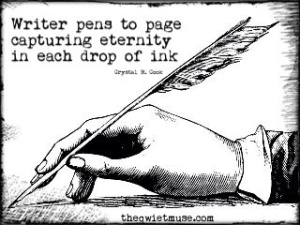
Writer - Haiku - Crystal R. Cook

Poetry is something which comes from within, composition and form are secondary to the words which will bring meaning and life to the page, but important still. Poetry comes in many forms, perfect to one – nonsense to another. What matters is the author’s voice tickling the reader’s ear through the whispered words of the page.

You needn’t use big words or flowery verse, it doesn’t have to rhyme, and it doesn’t have to be explained; the words and the composition of them should suffice. Writing poetry can be healing, thought-provoking, and at times, profound to both the writer as well as the reader. The perfect poem is the one that touches your soul when you write it, and invites the reader to become one with your words.
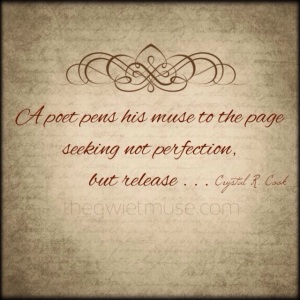
Seeking release

The laureate lamented
for her words were skewed,
her altiloquence mistaken
as being quite rude.
Her style clinquant,
her affectation too much,
too many mistakes,
like catchfools and such.
Circumlocution
and too many clichés
made all of her readers
turn quickly away.
What she thought
to be eloquent
was really quite fustian;
due to forced rhyme
she lacked any . . . lyricism?
Pedantry ad nauseam,
not even done right,
left the young writer
feeling contrite.
She vowed to improve,
she promised to change
and pay more attention
how her words were arranged.
Convinced of her talent
she started again,
but was soon held up
by heteronyms.
She stopped and she sighed,
then she started to cry,
for her poetic juices
had completely run dry . . .

CRC

Simply awful with that bit of forced rhyme and the ridiculous use of unnecessarily big words. I must admit though, it was quite fun to write.

Poetry doesn’t have to rhyme. If you cannot rhyme well, you shouldn’t rhyme at all. Forced rhymes destroy what may otherwise be a fine piece of work. Rhymed poetry needs to have a rhythm; it needs to flow seamlessly as it is read. It needs to make sense.

If writing a rhymed piece, ideally each stanza should have the same amount of lines; the rhyme scheme needs to be consistent. There are several ways to craft a rhymed poem, once you’ve chosen your style, remain true to it throughout the piece, the jarring effect of switched up rhyme schemes can throw a reader off.

Every line in a poem does not need to be capitalized; many writers tend to do this, for the reader though, it is often hard to distinguish where one thought ends and another begins. A poem can have commas, periods, and question marks. These details can certainly serve to enhance your work; don’t be afraid to use them.

Poetic beauty is personal passion, as it is with any art. There are those who love and admire the work of Picasso and others who are perplexed and not attracted to it in the slightest, yet both recognize the value of the art itself.

Words never rest,
an endless dance
of thoughts
and epiphanies,
which must
be forgotten
or given
life eternal
upon a page.

Words
ease fear,
create terror,
heal, hurt,
make
insanity
the norm.

They never
cease,
they never
fade,
never fail,
never stop.

CRC
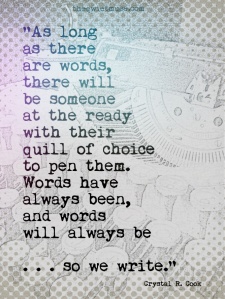
We Write by Crystal R. Cook

And because we spoke of rhyme . . .

Stymied by Rhyme?
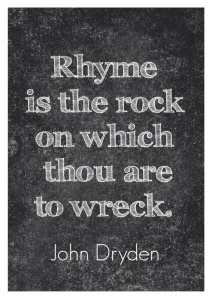
Rhyme

To rhyme or not to rhyme, if you choose to rhyme, you must rhyme well, for if you don’t, it will sound like . . . Well, you understand don’t you?

From the Devil’s Dictionary by Ambrose Bierce – RIME, n. Agreeing sounds in the terminals of verse, mostly bad. The verses themselves, as distinguished from prose, mostly dull. Usually (and wickedly) spelled “rhyme.”

When asked about English words without a rhyme, most will quite correctly say orange, purple and silver. There are actually many words in the English language lacking a partner in perfect rhyme.

If it’s true rhyme you’re looking for, you may want to steer clear of the words: anything, January, stubborn, apricot, dictionary and xylophone. Good luck with chaos, angry, hostage, rhythm, shadow, circus, crayon and glimpsed. Angst and empty, depth and width will be tough to rhyme, just like glimpsed and else and diamond and chocolate. Penguin and galaxy do not have any true rhymes, nor does elbow or engine, anxious or monster.

A perfect rhyme, sometimes referred to as true rhyme or full rhyme, is defined by the American Heritage Dictionary of the English Language as; a rhyme in which the final accented vowel and all succeeding consonants or syllables are identical, while the preceding consonants are different, for example, great, late; rider, beside her; dutiful, beautiful.

Pure rhyme can be broken down even further. Words such as dog and log are single pure rhymes. Silly and willy would hence be referred to as double pure rhymes. An example of a triple pure rhyme would be mystery and history.

The longer the word, the harder it will be to find a perfect rhyme, this doesn’t mean they cannot be used in the context of rhyme however. Para-rhymes are defined as a partial or imperfect rhyme, often using assonance or consonance only, as in dry and died or grown and moon. This is also called half rhyme, near rhyme, oblique rhyme, slant rhyme or forced rhyme. This refers to words that do not completely rhyme, but use like sound to form the desired effect. A common example is the word discombobulate, to create a fluid sounding rhyme, three syllables must be utilized, populate would work well as a half rhyme in this instance. Hill and hell or mystery and mastery are examples of para-rhyme.

Masculine rhyme, or monosyllabic rhyme, is among the most common; this technique stresses the final syllable of each word, as in sublime and rhyme, or went and sent. Feminine rhyme differs in that the stress is on two or more syllables such as pleasure and treasure or fountain and mountain. Identical rhyme is simply using the same word twice.

There are various other examples of rhyme; eye rhyme is a rhyme consisting of words, such as lint and pint or love and move with similar spellings, but different sounds. Rich rhyme is a word rhymed with its homonym such as blue with blew, guest with guessed.

Scarce rhymes are words with limited rhyming alternatives like wisp and lisp, motionless and oceanless. Wrenched rhyme is the rhyming of a stressed syllable with an unstressed syllable as in words like lady and bee or bent and firmament.

Internal and external multi-syllable rhymes utilize the rhyming of more than one word, in this example, bleak and seek are internal rhymes; words within the body of the stanza, while night and light are external rhymes and fall at the end of a line.

So she found him
in the bleak of night,
lost on his quest
to seek the light.

Assonance rhyme is the matching of the vowel sounds, feast and feed, fever and feature. In syllable rhyme, the last syllable in each word is matching, pitter and patter, batter and matter. Consonance rhyme is matching the consonants in each word, her and dark. Alliteration is matching the beginning sounds of each word, often used in a series; perfect, poetic, personification.

Many people wrongly assume writing a rhymed poem is an easy task, until they actually try to write one, that is. There is much more to it than seeking words that rhyme, but we’ll discuss it at length some other time.

Crystal R. Cook

10952346_10204542112366345_6584963774473823971_n

The Documentation of Experience -Writing

My Words by Crystal R. Cook

It makes my heart smile when someone reads the words I pen and they resonate with them in some way. I feel blessed when they respond, when I realize the message I intended to convey came across as I’d hoped it would.

Often, I write to share a truth or an insight I’ve gleaned at some point in my life. If it taught me something, perhaps it can do the same for someone else, or at the very least, validate a truth of their own or set them on a path they may not have known was there.

There is something important I wish to impart when it comes to what I give to the page, I am not necessarily going through what I write of in the exact moment I write of it, sometimes, but not always.

A writer’s mind, at least my mind, does not completely maintain a foothold in the here and now. The ebb and flow of my stream of consciousness is forever churning and changing direction, my thoughts rushing in as raging rapids or as gently trickling droplets.

I can think a thought or experience a moment of epiphany about depression or anger or grief during the happiest of times, sometimes I share these thoughts because I still need to learn something from them or simply set in stone what has already been cultivated from the garden of my experience. I share these thoughts in the hope someone may need to hear what I have to say.

Writers can also be a wee bit melodramatic — I once wrote two agonizing pages about fear, anxiety, and what was lurking in the shadows just waiting to get me. In actuality, I was in the park on a sunny afternoon watching my children frolic, yes they frolicked, and when I looked down I noticed an eensy weensy spider coming toward me at a speed which made me slightly less than comfortable; it startled me. I went with it. I didn’t have any curds and whey, so I ran with the whole deepest, darkest fear thing.

There are times I write of lessons learned long ago and my words may convey a sense of the now, when in fact, I have long since moved past that moment. I do this for those who may need to hear it in the now and might relate. I do this because it is a part of my story, it is how I felt, who I am, and how I came to be.

Sometimes I find a few scribbled words scratched upon a crumpled piece of paper I’ve left between the pages of a book, something I once wanted to write, but somehow forgot about, and it all comes back to me, begging to be set free and given its say. I almost always oblige it.

I can travel my own timeline as a silent observer, I take notes and create a written history of the events, the feelings . . . I capture them and breathe life back into them so none of it is forgotten or experienced in vain.

Everything I write is a truth, it may be an old truth realized and finally made tangible in print. It may be something I hadn’t felt the need to share just yet, or perhaps I was simply waiting for the right words to find me.

Maybe those words were just waiting for the right person to share them with.

Crystal R. Cook