Tag Archive | reading

Magical Doorways

Magical Doorways

The classics . . . pieces of art and history, penned by the hands of literary masters, caretakers, and keepers of words; their works have stood the test of time, remaining while all else changes . . . forever.

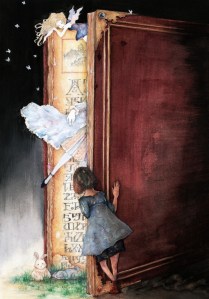
My childhood was filled with magic and mystery, drama and suspense. I was a time traveler and a princess, a mighty hero and a damsel in distress. I’ve flown round the world and journeyed to the center of the earth. I had grand adventures when I was young. I could go anywhere and do anything because my mother led me to a me a magical doorway, an entrance into another world.

She gave me a wonderful gift when she taught me to read, it was my key to unlock the doors of imagination and knowledge. When I was six years old I found a weathered copy of The Old Man and The Sea, I read it front to back without pause; I’ve read it many times since. The same softly covered book, printed and bound in nineteen fifty-two, holds a place of honor in not only my memory, but in my home as well. Once I stepped beyond the boundaries of everyday reality into the wondrous world of literature there was nothing I did not desire to read.

Herman Melville and Ernest Hemingway were my best friends. Shakespeare and Mark Twain accompanied me to school quite often. Hawthorne and Homer waited patiently for me at the end of each day. I’ve been to secret gardens and lived in enchanted castles. I’ve known the greatest of love and have felt the deepest of sorrow. I played with Tom Sawyer and Huckleberry Finn; I’ve even been to the moon and back again. I’ve sat along the shores of the great grey-green, greasy Limpopo River with the elephant’s child and pondered what the crocodile ate for diner. I bravely ventured into the mind of Poe.

I remember going to the fair with Charlotte and Templeton and investigating every mystery with the Hardy Boys. I was in the skiff with the old man Santiago and I felt the wind in my hair as I rode atop Black Beauty. My tears stained the pages where the red fern grew.

Aesop, Anderson and Kipling often joined me for lunch with James and his companions beneath the giant peach tree in the backyard. I traveled with Bilbo Baggins of Bag End and met the great wizard Gandalf. I befriended elves and fought ogres in search of the ring.

I held hands with Jesus in stories from the Bible and I was with Daniel in the lion’s den. I stood atop Mt. Ararat and gazed upon the most beautiful rainbow with Noah. I’ve been both young and old, taken many forms and seen many places. I’ve ridden high atop unicorns and slain dragons. I’ve even soared on the wings of angels.

I will forever be thankful to those who penned their dreams and fantasies, for in doing so; they bestowed upon me a treasure of great worth. I adore my books, though the pages have aged and the bindings have seen better days, I still go back to them, I visit my old friends often, adding new ones along the way. I never know where the magic door will take me or who will be my guide. It may be a quest for infinite wisdom or a marvelous retreat into days long since passed. Perhaps the future awaits my arrival on some distant star.

Who knows, maybe it lies within me, just waiting to be printed and bound . . .

Crystal R. Cook

Synaptic Connection Lost – Send Help

Testing, testing, 1–2–3. Once upon a time, in a land far away . . . the swift brown fox jumped over the lazy dog . . .

Pardon me, just trying to be certain I’ve not forgotten how to type. It seems the keys are in working order, my fingers easily find each one, so typing is not the issue, it appears I still remember how to form words in a manner resembling sentences.

I guess I can check those excuses off my * why on earth am I not writing? * list.

There must be an internal malfunction disrupting the usual flow of words I rarely have to fight with such vigor to release.

My typically energetic neurons have been slacking off in the synaptic connection department, maybe the receptors are busted. The problem must lie somewhere within those billions of nerve cells running my information processing center. My synaptic connections are simply not synapsing and connecting.

Perhaps my neurons need input. I have hundreds of books from which to choose, all with the potential to jump-start my ridiculously stubborn mind. If I could just syphon all the excess and unneeded and unwanted thought from it, I’m certain I would regain coherent and functional use of the blasted thing.

The closest I’ve come to actual writing these past weeks was changing the words to Green Eggs and Ham to reflect my disdain for people. Sam-I-Am meets his demise at the end. A dear friend suggested I seek pharmaceutical intervention after reading it. I assured her I was properly medicated, but she seemed doubtful.

So, woe is me.

I suppose I will peruse my overflowing shelves for a good read, suggestions are welcome.

       INTERMISSION

I’ve narrowed my choices down to four, but I cannot come to a final decision.

The Bell Jar —Sylvia Plath

image


The Professor and the Madman — Simon Winchester

image


Miss Peregrine’s Home For Peculiar Children — Ransom Riggs

image


The Fourth Hand — John Irving

image


Please feel free to provide your thoughts as mine are wholly unreliable at this time.

*ish* day . . .

image

I keep telling myself I need to get up and do something at least relatively productive today. The problem is, I don’t much care for being told what to do, so I am rather at odds with myself at the moment. On one hand, I am trying to convince myself it’s my own personal desire to rise and be responsible, on the other, I am my own authority figure and feel the need to rebel.

I’m fairly certain I’ve mentioned it before, but in case you missed it, I’m not entirely crazy. I can’t be the only one with an ongoing, internal discourse in regard to how best spend the day ahead. At the heart of this particular issue is this, I’m tired. Physically, I’m awake, chipper even. Alright, that’s an exaggeration almost tantamount to a lie, but I am awake and in a fairly fair(ish) mood. It will be safe to remove the ish once I’ve finished my coffee, at least I am fairly certain(ish) it will be.

My current level of tired goes beyond the physical. I am weary in many ways at my very core. It’s like everything in me just realized it’s been running on empty for too long and the gears have ground to a halt. Maybe this is why I drink too much coffee. Perhaps I am feeding my fragile engine with the wrong fuel. Nah, it just needs something in addition to my beloved brew.

~ OR ~ I am just being lazy and all of this diatribical wordage is nothing more than me justifying my reluctance to do laundry.  *diatribical – it is a word today. If the dictionary can now include hashtag, I can play with my words as I wish. Octothorpe, by the way, it is an octothorpe. 

I’ve approximately two, possibly three more sips in my cup and am contemplating a second fix, oh, but that requires action on my part, it’s a worthy enough endeavor I suppose. Well worthy. I may make some tea in lieu of the java, sounds rather delightful actually. I was hoping my rambling would lead me and spur me forward in my quest for motivation, but thus far the most appealing thing I’ve come up with is sitting on the porch with my coffee, or tea, and losing myself completely between the pages of a book.

I may get dressed today, the probability of remaining in my pajamas is likely though, quite likely as a matter of fact since doing the wash has not yet made it to the top of my to-do list for the day. My cup is now emptied and a decision has to be made, I’m flipping a coin . . .

Crystal R. Cook

W.A. – It affects you, I guarantee it.

image

If you have any of these warning signs, you are one of the many people afflicted with WA –

  • an unusually and unnecessarily large collection of writing instruments.

  • an over abundant supply of paper, notebooks, journals, etc..

  • overflowing bookshelves, the compulsion to buy books even when you have unread stacks of them next to your bed, couch, and kitchen table.

  • an overwhelming compulsion to blog, read blogs, and comment on blogs.

WA is a newly recognized and widespread epidemic of addiction affecting people around the globe. This affliction has silently consumed lives for centuries, some may argue it is a harmless addiction, though many have been known to suffer from co-morbid conditions such as alcohol and caffeine abuse.

Negative side effects include insomnia, malnourishment, and social deficits. Family members of those living with WA have reported episodes of withdrawal, lack of spontaneity, decreased desire to engage in family activities, lack of personal care, and sustained periods of restlessness in those diagnosed.

Currently, the typical diagnostic criteria used to determine addiction is not apparent in all cases, many go unrecognized by the medical and psychiatric communities leading to a majority of cases being diagnosed by family members. Many of those with WA are self diagnosed.

In many instances you may hear it referred to as a syndrome in lieu of an addiction. A majority of those with WA do not see it as an addiction, they believe they were born with WA. Popular theory and current research suggests there may be a genetic component involved.

Since the diagnostic criterium for addiction is not always met, WA, also known as Writing Addiction, or Writing Syndrome, is often a diagnosis of exclusion, meaning you know your addicted if you’ve excluded everything else in life aside from the written word.

imageIn fact, if you are reading this you may have one of two very real addictions, perhaps even both. If you are reading simply because you must read you more than likely have RA, Reading Addiction. If you are reading this and already thinking of what to write about it, it’s safe to say you are a Writing addict. If you are reading this out of sheer compulsion AND thinking of what to write, you are not alone, a majority of those diagnosed carry a dual diagnosis referred to as RAWA, Reading and Writing Addiction. There is no shame.

Writing addiction is not something you plan. It is an all-encompassing desire, the more you write the more you need to write. Like most addictions, it begins to consume you. At first it’s just jotting things down now and then, a bit of poetry here, a little prose there and soon you’re writing stories and sonnets and epic works of words late into the night.

It’s a secret addiction in the beginning, harmless to most. Writing addicts typically start in their spare time. It doesn’t take long until spare time is no longer enough; it begins to creep into their day. When you’re supposed to be doing bills an idea will hit and next thing you know you’ve written half a chapter on the back of your electric bill.

It doesn’t end there. Dinners get burned, kids are late for school, laundry piles up and you forget to feed the dogs, you write about it though. Hungry Dogs, a Tale of Sad Tails. When it first begins it’s easy to hide, but soon you get careless and scraps of paper litter the countertops and the dressers, notebooks and journals are in every room of the house.

Your desktop is filled with papers and coffee cups. Oh yes, coffee cups. Once the addiction has you in its clutches you forego nourishment for a good old Cup-o-Joe to keep you going. Snack foods sustain life. By the time family and friends see the signs it’s too late. No one says anything until you arrive at school in the afternoon to pick up your children wearing yesterday’s pajamas.

By the time anyone suspects there is a problem it’s already too late. Sure, they can hold interventions; they can beg and plead, but the need to write simply cannot be overcome. Once you have it, you have it for life. Eventually those who love you will accept the reality of your life. You are a writer.

There isn’t much you can do for someone with writing addiction except accept them and love them imagejust as you did before they picked up a pen. As previously mentioned, in some cases it appears to be genetic; many children of writing addicts are themselves addicts by the time they reach puberty. The same can be said for the offspring of reading addicts. There has yet to be a cure, its doubtful there ever will be.

I myself am a reading and writing addict. It began when I took my first breath, my family has tried to put an end to it, but they’ve never succeeded. They’ve never even come close. They know I will write about them if they push it too far. Do they think I don’t know casserole will burn if I don’t stop writing long enough to take it out of the oven? I mean seriously, why else would I keep a fire extinguisher at my desk. I’m one step ahead them.

In conclusion, writing can in fact, be an addiction. There is no way to know who will become a slave to the written word. There is no way to stop it once it has begun. I suppose those of us with writing addiction are enabling the reading addicts among us, they can’t get enough of what we do . . . but then, are they not in a sense encouraging our own addiction to writing? And what of those of us with the dual addiction, we are our own worst enemy and best friend; it is a vicious circle, one with no end.

image

If a cure is ever found I’m heading for the hills. I wonder if I can get high-speed Internet service up there . . . no matter, paper, pens and solitude is all I need to feed the hunger. No twelve step programs for me, I’ll write one for anyone who wishes to work through their beautiful addiction though, not that anyone would.

Crystal R. Cook

Resurrected to share for the blog share learn linky party!

#MidLifeLuv Linky

We should all be giving trees

image

In 1964, The Giving Tree by Shel Silverstein, was published. In 1974, my mother gave me the gift if it.

The Giving Tree became my saving grace and my constant companion. The pages brought me hope; they taught me, and in many ways helped mold me into the person I’ve become. I need not open the book to tell the story; it was long ago ingrained within me. When my children were born I gave to them the very same gift my mother had given me and I’ve watched it become a part of them as well.

I wonder if Shel Silverstein knew when he penned those words just how important they really were. Was he merely writing a children’s story, to be read to sleepy little ones as they drifted off to dream or did he have a greater purpose? I think he did indeed have a much greater purpose in mind.

My children, now no longer children, still cherish the book as much as I do. They read it to me every now and again and my eyes never fail to fill with tears. The tale tucked safely between the covers of the book is a timeless masterpiece of humanity all should be blessed to read.

It is a story of selfless giving and sacrifice. It tells of youthful folly and selfish need, of acceptance and unconditional love. With simple style and unexpected grace, Shel Silverstein brings his story full circle and the moral resonates within the reader, stirring emotions and provoking thought.

Simple illustrations of black against white become colorful visions through the words they portray. I can see the grass and the green of the tree with bright red apples decorating the strong branches, lush with leaves and life. The renderings show such emotion, just sketches really, but they have life when you look upon them.

The Giving Tree is so much more than a children’s book. Readers of all ages would do well to learn the lessons so wonderfully written and shared. From the pages of this simple book I learned to look at the needs of others before taking what I wanted, even though they may have been given freely. I learned to give what I could; I learned to think of the future while living in the present. I learned to value friendship, I learned love was a two-way street and pure and precious love is forever.

This has always and will always be, one of my favorite pieces of literature. The pages may be few, but they hold infinite wisdom. They tell of change. They tell of lessons learned. They tell of growth. There is a beginning and an end, an end that is itself a new beginning of sorts. A moment of self-realization everyone must eventually face. The book ends with an epiphany of sorts, one some learn too late in life.

We should all be giving trees . . . Some of us are still full and vibrant, with much to give, some of us have given so much we fear we have nothing left to give. Ironically, what we still have is often the thing needed most by another.

Crystal R. Cook

Raising Potential Writers

image
A good writer is first a good reader . . .

William Faulkner once said, “Read, read, read. Read everything trash, classics, good and bad, and see how they do it. Just like a carpenter who works as an apprentice and studies the master. Read! You’ll absorb it. Then write. If it is good, you’ll find out.”

Introducing children to the world of literature is one of the greatest gifts you can give them, regardless of whether or not writing is in their future. Before they can read, read to them, help them fall in love with words.

“Reading is to the mind what exercise is to the body.” Sir Richard Steele

Books captivate and spark imagination. Once they begin to read, they begin to learn, let the masters be their teachers. When I was six years old I read The Old Man and the Sea by Ernest Hemingway, I was enraptured by the tale and soon sat down to write a story of my own. Some children seem to be born with a story within them, just waiting to be told.

“The difference between the right word and the nearly right word is the same as that between lightning and the lightning bug.” Mark Twain

Teach them to speak properly. If they are to write, they must know how to speak, and speak well. The proper use of words and a good vocabulary will only serve to enhance every aspect of their writing as well as their future relationships and employment opportunities. This is something you can do from the time they are babies, baby talk can be fun when it’s time to have fun, but I’m a firm believer that children need to be spoken to in the way we want them to one day speak.

Encouragement will foster confidence; too much encouragement can lead to disappointment, reserved honesty is sometimes best. I would never tell my children something was wonderfully written if it were not, instead, I would find the good in it, then offer suggestions for the parts that could use some attention. Read what your child writes and tell them you want to read more, your enthusiasm will fuel their own.

“There is only one trait that marks the writer. He is always watching. It’s a kind of trick of the mind and he is born with it.” Morley Callaghan

Teach them to see the world around them, help them become constant observers. Inspiration comes in many forms; sometimes the most insignificant of things will lead us to the most significant thought. It teaches them to be aware of themselves and all that surrounds them. It teaches there is so much more to be seen than most people realize, they’ll learn to see what others may not, they’ll experience so much more of life when they learn to look beyond the ordinary.

Two of my four children are writers, amazing writers, they are all avid readers and eloquent speakers as well. When they were young, one of their favorite pastimes was Mad Libs. Without realizing it, they were learning with each silly story. Before my daughter was five she knew what adjectives and pronouns were, she knew the difference between a verb and an adverb. They learned new words and how to spell them through family games of Scrabble.

I often sat with them, pen and paper in hand, and we wrote stories together, taking turns, paragraph by paragraph. Here they learned the proper usage of grammar and punctuation, they learned to be creative. They learned to show, not tell. They found their own voices within the words they penned to the page. Looking back on their earliest writing brings both smiles and tears, their innocence spilled upon page after page, they are some of my most treasured possessions.

“Advice to young writers? Always the same advice: learn to trust your own judgment, learn inner independence, learn to trust that time will sort the good from the bad including your own bad.” Doris Lessing

I encouraged them to keep journals, it’s important to have a place to write anything and everything. To me, it is in the pages of a journal where you learn the most about who you really are. There can be no self-expression without a sense of self.

I taught them to never throw away what they’ve written, even if they thought it wasn’t the greatest, I urged them to tuck it away and maybe someday revisit and rework, or at the very least, look back on to see how far they’ve come. One of my greatest regrets as a writer is the loss of work I deemed unworthy at the time.

As teenagers, I encouraged them to write often, offering critiques and advice along the way. Constructive criticism can be a difficult thing to take in the beginning; they learned to grow from it. They found online writing groups and sought out those teachers willing to take time and become a part of their journey as they wrote their way into each new chapter of their lives.

Now, as adults, they continue to write as they pursue other dreams and opportunities. Their ability to express themselves in both the written and spoken word is remarkable and rarely goes unnoticed. It wasn’t my intent to raise writers, my goal was to teach them the importance of words, language, and expression. The words we say follow us through life, they can open doors or they can close them.

I place great value on words, they are how we let the world know who we are, what we stand for, what we desire, need, and cherish in life. Their worth is immeasurable. Teaching a child the wonder of words, not just how to say them, but how to feel them and bring them to life, is as I said, a gift.

Crystal R. Cook
 

This effects us all, it affects us too. I can almost guarantee you have WA.

WA is a recognized and widespread epidemic of addiction affecting people from around the globe. This affliction has silently consumed lives for centuries, some may argue it is a harmless addiction, though many have been known to suffer from co-morbid conditions such as alcohol and caffeine abuse.

Negative side effects include insomnia, malnourishment, and social deficits. Family members of those living with WA have reported episodes of withdrawal, lack of spontaneity, decreased desire to engage in family activities, lack of personal care, and sustained periods of restlessness in those diagnosed.

Currently, the typical diagnostic criteria used to determine addiction is not apparent in all cases, many go unrecognized by the medical and psychiatric communities leading to a majority of cases being diagnosed by family members. Many of those with WA are self diagnosed.

In many instances you may hear it referred to as a syndrome in lieu of an addiction. A majority of those with WA do not see it as an addiction, they believe they were born with WA. Popular theory and current research suggests there may be a genetic component involved.

Since the diagnostic criterium for addiction is not always met, WA, also known as Writing Addiction, or Writing Syndrome, is often a diagnosis of exclusion, meaning you know your addicted if you’ve excluded everything else in life aside from the written word.

In fact, if you are reading this you may have one of two very real addictions, perhaps even both. If you are reading simply because you must read you more than likely have RA, Reading Addiction. If you are reading this and already thinking of what to write about it, it’s safe to say you are a Writing addict. If you are reading this out of sheer compulsion AND thinking of what to write, you are not alone, a majority of those diagnosed carry a dual diagnosis referred to as RAWA, Reading and Writing Addiction. There is no shame.

Writing addiction is not something you plan. It is an all-encompassing desire, the more you write the more you need to write. Like most addictions, it begins to consume you. At first it’s just jotting things down now and then, a bit of poetry here, a little prose there and soon you’re writing stories and sonnets and epic works of words late into the night.

It’s a secret addiction in the beginning, harmless to most. Writing addicts typically start in their spare time. It doesn’t take long until spare time is no longer enough; it begins to creep into their day. When you’re supposed to be doing bills an idea will hit and next thing you know you’ve written half a chapter on the back of your electric bill.

It doesn’t end there. Dinners get burned, kids are late for school, laundry piles up and you forget to feed the dogs, you write about it though. Hungry Dogs, a Tale of Sad Tails. When it first begins it’s easy to hide, but soon you get careless and scraps of paper litter the countertops and the dressers, notebooks and journals are in every room of the house.

Your desktop is filled with papers and coffee cups. Oh yes, coffee cups. Once the addiction has you in its clutches you forego nourishment for a good old Cup-o-Joe to keep you going. Snack foods sustain life. By the time family and friends see the signs it’s too late. No one says anything until you arrive at school in the afternoon to pick up your children wearing yesterday’s pajamas.

By the time anyone suspects there is a problem it’s already too late. Sure, they can hold interventions; they can beg and plead, but the need to write simply cannot be overcome. Once you have it, you have it for life. Eventually those who love you will accept the reality of your life. You are a writer.

There isn’t much you can do for someone with writing addiction except accept them and love them just as you did before they picked up a pen. In some cases it is genetic; many children of writing addicts are themselves addicts by the time they reach puberty. The same can be said for the offspring of reading addicts. There has yet to be a cure, its doubtful there ever will be.

I myself am a reading and writing addict. It began when I took my first breath, my family has tried to put an end to it, but they’ve never succeeded. They’ve never even come close. They know I will write about them if they push it too far. Do they think I don’t know casserole will burn if I don’t stop writing long enough to take it out of the oven? I mean seriously, why else would I keep a fire extinguisher at my desk. I’m one step ahead them.

In conclusion, writing can in fact, be an addiction. There is no way to know who will become a slave to the written word. There is no way to stop it once it has begun. I suppose those of us with writing addiction are enabling the reading addicts among us, they can’t get enough of what we do . . . but then, are they not in a sense encouraging our own addiction to writing? And what of those of us with the dual addiction, we are our own worst enemy and best friend; it is a vicious circle, one with no end.

If a cure is ever found I’m heading for the hills. I wonder if I can get high-speed Internet service up there . . . no matter, paper, pens and solitude is all I need to feed the hunger. No twelve step programs for me, I’ll write one for anyone who wishes to work through their beautiful addiction though, not that anyone would.

Writer

We Write by Crystal R. Cook
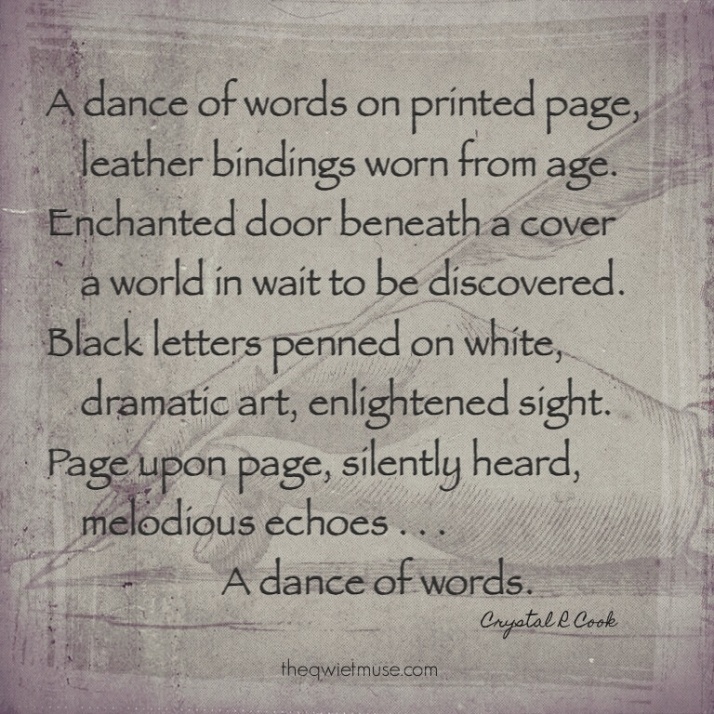
As long as there are words, there will be someone at the ready with their quill of choice to pen them. Words have always been, and words will always be . . . so we write.

I write because it sustains me, it brings me peace. I write so I will live on in my words when my time on earth has passed. My voice immortalized forever upon a page in hopes the children of my grandchildren may one day hear me and know who I once was. I hope they know when they hold my words in their hearts, they are holding me.

Writing is the sweetest of freedoms. It breaks the chains which try to bind us to this world. It is freedom to release and let go of angst or anger, sadness or fear. Freedom to soar above this plane of existence and reach heights never before reached. When we write we are free to be all of who we are when the world seeks to quell our voices.

I must share the words that well within me. I must write of my joys and my sorrows, my memories and my dreams. I must share the knowledge I have gained and I must write to learn, for there is much to be learned. In my words I am real. No pretences, no expectations and no judgments.

To some, writing is as essential as the air around them, each word a life-sustaining breath, a beat of their heart. Words hold healing for the one who writes them as well as the one who reads them; there is power in each stroke of the pen. The written word is a gift of greatest worth.

Writers teach, they entertain, they inspire and they motivate, they capture and they captivate. If writers ceased to give life to words, knowledge would no longer be gained, memories would fade, and the most important of things would be forever forgotten.

Some writers learn to write, honing their craft to create, others were born with the blessing of words ready to flow from their fingertips, all share their gift with the world, leaving the mark of their soul on humanity. Many writers have helped mold the lives of those who read their words. People are shaped, in no small part, by what they read in life; they carry the words within them. Enlightenment is often found in the pages of a book, a simple thought, printed and bound, can be a life changing epiphany for someone else. What greater gift could a writer give or receive? I can think of none better.

Writers must write. I truly don’t think there are words enough to explain just why we dance this dance with words. We simply must write . . .

Crystal R. Cook