I have eleventy thousand things to do, that’s just a rough estimate, mind you, (eleventy is a thing, my thing) — by my estimation I have time enough to complete approximately three of these things, and this is assuming I remove myself from the computer reasonably soon.
Problem. I would rather write. Or read. Or nap. –sigh-
Of course, writing is among the eleventy thousand things I must do, and for some of this writing, looming deadlines are attached. I’ve already procrastinated past the point of saying it can wait one more day. Today is kind of that day. –ugh-
Since the new bloggy bit I would rather be writing is going to have to wait, I’m dusting off the cobwebs from one of my early posts, which was seen by five people according to the statistical analysis of The Qwiet Muse. Actually, I am going to kind of, sort of, merge two posts together since the subject matter fits, and now that I’ve read them, I find pieces and parts I want to change, fix, adjust, add to, and . . . –argh- no time.
Now I must be productive and responsible and –extended sigh- get to work . . . I am going to need more coffee.
Poetic Perfection?
Is there truly such thing as a perfect poem? What reads like unblemished perfection to one, may not receive the same praises from another. Poetry is a subjective art. There are guidelines a writer can follow which may endear their words to a greater audience of readers. The words of a poem provide the reader sustenance with which they can quell their hunger, but the presentation, the way in which the writer chooses to craft their words upon a blank canvas, is important to a readers palate as well.
A poem needn’t be epic in length, think of the power the words of haiku hold.
Poetry is something which comes from within, composition and form are secondary to the words which will bring meaning and life to the page, but important still. Poetry comes in many forms, perfect to one – nonsense to another. What matters is the author’s voice tickling the reader’s ear through the whispered words of the page.
You needn’t use big words or flowery verse, it doesn’t have to rhyme, and it doesn’t have to be explained; the words and the composition of them should suffice. Writing poetry can be healing, thought-provoking, and at times, profound to both the writer as well as the reader. The perfect poem is the one that touches your soul when you write it, and invites the reader to become one with your words.
The laureate lamented
for her words were skewed,
her altiloquence mistaken
as being quite rude.
Her style clinquant,
her affectation too much,
too many mistakes,
like catchfools and such.
Circumlocution
and too many clichés
made all of her readers
turn quickly away.
What she thought
to be eloquent
was really quite fustian;
due to forced rhyme
she lacked any . . . lyricism?
Pedantry ad nauseam,
not even done right,
left the young writer
feeling contrite.
She vowed to improve,
she promised to change
and pay more attention
how her words were arranged.
Convinced of her talent
she started again,
but was soon held up
by heteronyms.
She stopped and she sighed,
then she started to cry,
for her poetic juices
had completely run dry . . .
CRC
Simply awful with that bit of forced rhyme and the ridiculous use of unnecessarily big words. I must admit though, it was quite fun to write.
Poetry doesn’t have to rhyme. If you cannot rhyme well, you shouldn’t rhyme at all. Forced rhymes destroy what may otherwise be a fine piece of work. Rhymed poetry needs to have a rhythm; it needs to flow seamlessly as it is read. It needs to make sense.
If writing a rhymed piece, ideally each stanza should have the same amount of lines; the rhyme scheme needs to be consistent. There are several ways to craft a rhymed poem, once you’ve chosen your style, remain true to it throughout the piece, the jarring effect of switched up rhyme schemes can throw a reader off.
Every line in a poem does not need to be capitalized; many writers tend to do this, for the reader though, it is often hard to distinguish where one thought ends and another begins. A poem can have commas, periods, and question marks. These details can certainly serve to enhance your work; don’t be afraid to use them.
Poetic beauty is personal passion, as it is with any art. There are those who love and admire the work of Picasso and others who are perplexed and not attracted to it in the slightest, yet both recognize the value of the art itself.
Words never rest,
an endless dance
of thoughts
and epiphanies,
which must
be forgotten
or given
life eternal
upon a page.
Words
ease fear,
create terror,
heal, hurt,
make
insanity
the norm.
They never
cease,
they never
fade,
never fail,
never stop.
CRC
And because we spoke of rhyme . . .
Stymied by Rhyme?
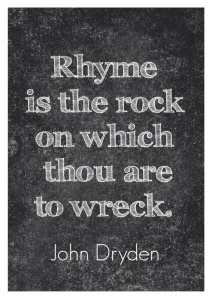
To rhyme or not to rhyme, if you choose to rhyme, you must rhyme well, for if you don’t, it will sound like . . . Well, you understand don’t you?
From the Devil’s Dictionary by Ambrose Bierce – RIME, n. Agreeing sounds in the terminals of verse, mostly bad. The verses themselves, as distinguished from prose, mostly dull. Usually (and wickedly) spelled “rhyme.”
When asked about English words without a rhyme, most will quite correctly say orange, purple and silver. There are actually many words in the English language lacking a partner in perfect rhyme.
If it’s true rhyme you’re looking for, you may want to steer clear of the words: anything, January, stubborn, apricot, dictionary and xylophone. Good luck with chaos, angry, hostage, rhythm, shadow, circus, crayon and glimpsed. Angst and empty, depth and width will be tough to rhyme, just like glimpsed and else and diamond and chocolate. Penguin and galaxy do not have any true rhymes, nor does elbow or engine, anxious or monster.
A perfect rhyme, sometimes referred to as true rhyme or full rhyme, is defined by the American Heritage Dictionary of the English Language as; a rhyme in which the final accented vowel and all succeeding consonants or syllables are identical, while the preceding consonants are different, for example, great, late; rider, beside her; dutiful, beautiful.
Pure rhyme can be broken down even further. Words such as dog and log are single pure rhymes. Silly and willy would hence be referred to as double pure rhymes. An example of a triple pure rhyme would be mystery and history.
The longer the word, the harder it will be to find a perfect rhyme, this doesn’t mean they cannot be used in the context of rhyme however. Para-rhymes are defined as a partial or imperfect rhyme, often using assonance or consonance only, as in dry and died or grown and moon. This is also called half rhyme, near rhyme, oblique rhyme, slant rhyme or forced rhyme. This refers to words that do not completely rhyme, but use like sound to form the desired effect. A common example is the word discombobulate, to create a fluid sounding rhyme, three syllables must be utilized, populate would work well as a half rhyme in this instance. Hill and hell or mystery and mastery are examples of para-rhyme.
Masculine rhyme, or monosyllabic rhyme, is among the most common; this technique stresses the final syllable of each word, as in sublime and rhyme, or went and sent. Feminine rhyme differs in that the stress is on two or more syllables such as pleasure and treasure or fountain and mountain. Identical rhyme is simply using the same word twice.
There are various other examples of rhyme; eye rhyme is a rhyme consisting of words, such as lint and pint or love and move with similar spellings, but different sounds. Rich rhyme is a word rhymed with its homonym such as blue with blew, guest with guessed.
Scarce rhymes are words with limited rhyming alternatives like wisp and lisp, motionless and oceanless. Wrenched rhyme is the rhyming of a stressed syllable with an unstressed syllable as in words like lady and bee or bent and firmament.
Internal and external multi-syllable rhymes utilize the rhyming of more than one word, in this example, bleak and seek are internal rhymes; words within the body of the stanza, while night and light are external rhymes and fall at the end of a line.
So she found him
in the bleak of night,
lost on his quest
to seek the light.
Assonance rhyme is the matching of the vowel sounds, feast and feed, fever and feature. In syllable rhyme, the last syllable in each word is matching, pitter and patter, batter and matter. Consonance rhyme is matching the consonants in each word, her and dark. Alliteration is matching the beginning sounds of each word, often used in a series; perfect, poetic, personification.
Many people wrongly assume writing a rhymed poem is an easy task, until they actually try to write one, that is. There is much more to it than seeking words that rhyme, but we’ll discuss it at length some other time.
Crystal R. Cook

If you liked what you just read, like it, pin it, share it, tweet it, stumble it! Thank you!


 The Qwiet Muse